
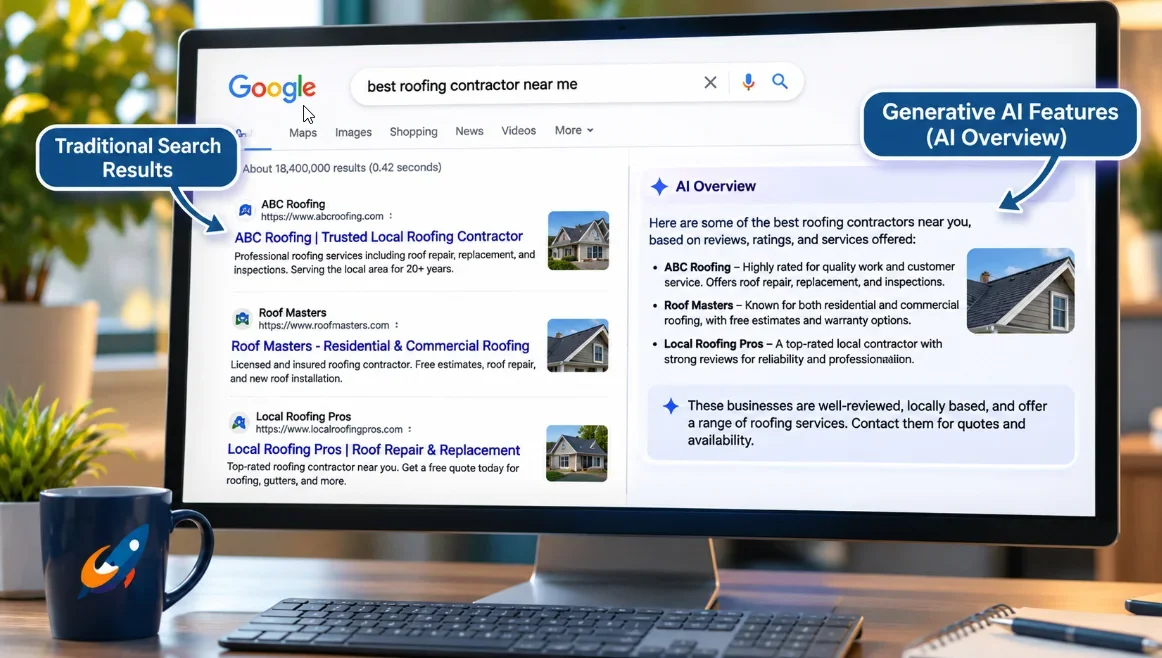
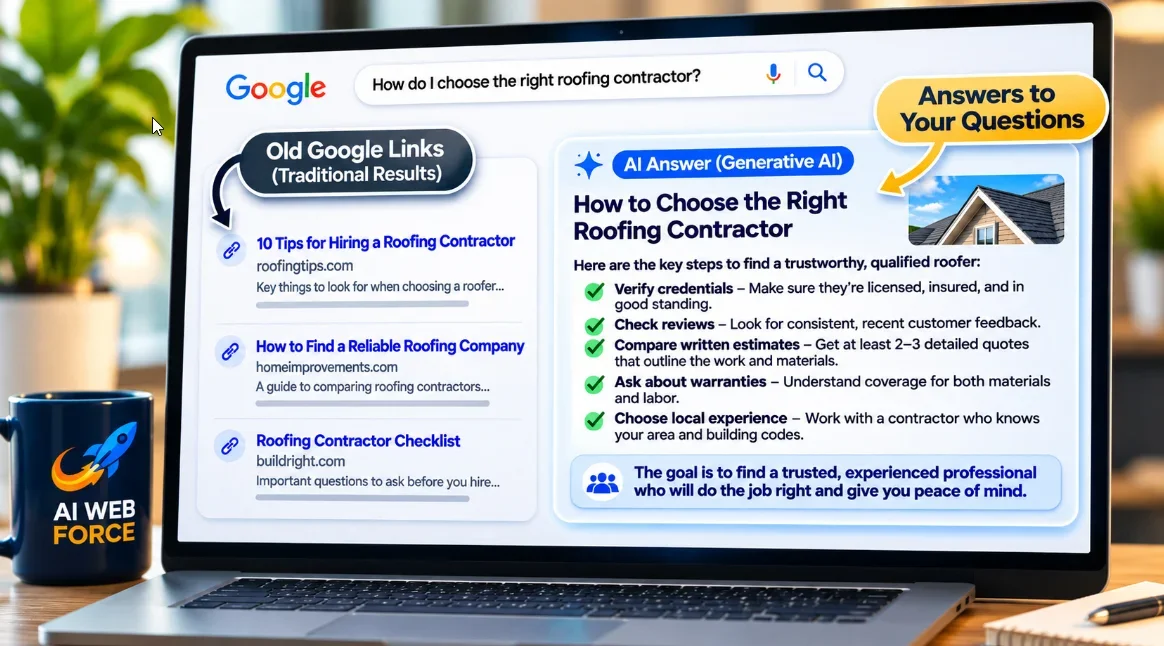
Imagine searching for a local roofing contractor in 2026: instead of a list of website links, you’re greeted with an AI-generated summary that answers your question, complete with recommendations, reviews, and actionable next steps.
This isn’t a distant possibility—it’s the new search reality, reshaping how people find, trust, and connect with local businesses. AI search is mainstream, and if you’re a business owner, it’s time to understand what it means for your digital visibility and growth.
Understanding the Shift: Is AI Search Going Mainstream in 2026?
-
Imagine searching for a local roofing contractor in 2026 and seeing an AI-generated summary at the top of your results. How is this shaping the way people find and trust local businesses today?
The shift toward AI-powered search is already evident. In today’s search results, people increasingly see smart summaries and direct answers generated by artificial intelligence, not just the traditional list of websites. When someone looks for a local service—like a roofing contractor—they now often encounter an AI summary that consolidates key information: business credentials, verified reviews, highlights from professional websites, and even up-to-date service offerings.
This generative AI approach doesn’t just present facts; it builds trust by delivering clear, concise, context-aware overviews in seconds. As a result, potential customers form impressions and decide faster, often without ever leaving the search results page.
For business owners, this mainstream rise of AI search is rewriting the rules of digital competition.
Your online reputation, service details, and unique selling points must now stand out for both traditional search engines and AI features that summarize or cite your content.
Adapting means not only refining your SEO for ranking, but also ensuring your business data is authoritative, accessible, and easy for new search algorithms to digest.
Put simply: being discoverable in standard search results is just step one; being selected and summarized by AI overviews is becoming the new key to local business success.
What You’ll Learn About AI Search, Generative AI, and Business Opportunity
-
How AI search is transforming user discovery patterns and what this means for your business visibility
-
The latest independent and platform research on AI-powered search adoption rates and changing user behaviors
-
The distinctions between traditional search engine results, AI summaries, and conversational search features
-
Practical steps every business owner should take to adapt digital marketing for generative AI features and stay competitive
By the end of this article, you’ll have a data-backed understanding of where AI in search stands today, actionable best practices for optimizing your site, and a clear perspective on the business opportunities emerging in this new era of search.
AI Search by the Numbers: Key Research from Google and Pew
-
Google’s 2.5 billion monthly AI Overviews users and 1 billion AI Mode users (source: Google platform reporting)
-
Pew Research Center: 60% of U.S. adults read AI search summaries; traditional search-result clicks drop from 15% to 8% when AI summaries appear (source: Pew observational research)
-
Clear distinction between platform usage reports and independent consumer research
If you’re wondering whether AI search is going mainstream, the numbers speak volumes.
According to Google’s recent platform reporting, its AI Overviews feature now boasts 2.5 billion monthly users worldwide, and more than one billion use “AI Mode” in search. That’s not just a spike in tech adoption; it’s a fundamental shift in the way businesses are discovered online.
Independent research echoes the trend. In 2024, Pew Research Center found that 60% of U.S. adults had read an AI-generated search summary. Even more compelling: when AI summaries appeared on a search engine results page, the click-through rate for traditional links dropped from 15% to just 8%.
This signals a seismic change: customers are staying on the search service itself, engaging with AI features rather than directly visiting websites as often as before. (For reference: Pew Research Center – The Rise of AI Search and Google Platform Reporting)
|
Comparing Traditional Search Results vs. AI-Powered Summaries and Conversations |
|||
| Type | What Users See | How Users Interact | Impact on Businesses |
|---|---|---|---|
| Traditional Search Results | List of links (“blue links”), snippets, ads | Scroll, select, click through to websites | Clicks split between top organic listings; visibility depends on SEO ranking |
| AI-Powered Summaries | AI summary at top, direct answers, highlighted sources | Read concise overviews, less likely to scroll/click beyond first page | Brand cited as authoritative gets trust, but fewer direct visits from search results |
| Conversational Search Engines | Interactive AI chat, context-aware advice, personalized results | Type or speak questions, receive tailored responses, follow-up queries | Businesses with useful and original content cited in AI responses gain customer trust and discovery |
How AI Search Differs: Traditional Google, AI Summaries, and Conversational Search Engines
How AI Search and Generative AI Features Work in Practice
-
Traditional search engine ranking vs. AI-powered summaries (AI summaries) and conversational responses
-
Example: A professional services website appearing in both standard search listings and as cited material in a generative AI search summary
The core difference between classic search engines and generative AI search features comes down to relevance and user intent.
Traditional search ranks pages based on factors like keywords, backlinks, and content quality. The top organic listings get the most clicks, while lower-ranked sites struggle to reach people. Most users skim snippets and blue links before deciding where to click.
With AI summaries, artificial intelligence reviews the web—often across millions of pages—and creates a concise summary directly related to a specific search intent.
For example, a professional services website might still appear in standard search results, but now it could also be cited as a trusted source in an AI-generated summary.
This means that original content, clear service descriptions, and customer-focused FAQs not only win in regular SEO but also increase the chances of being featured by generative AI features.
The practical takeaway for website owners: your digital authority isn’t measured merely by rank, but also by how useful and transparent your information is for AI to distill and present.
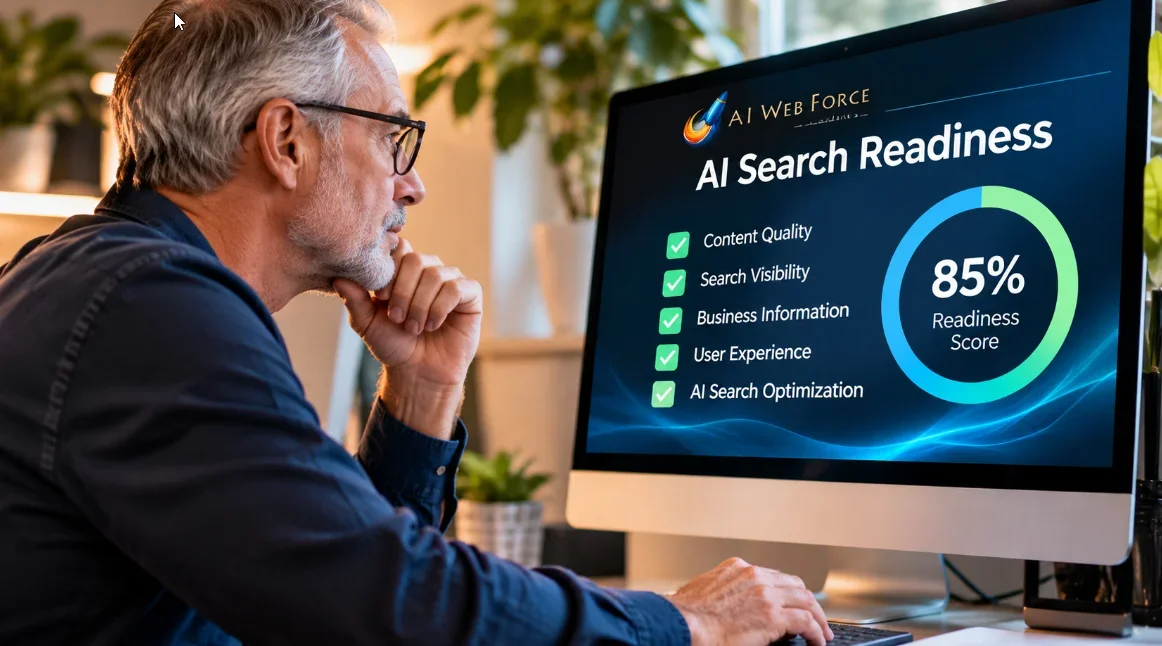
As you consider how to optimize your site for these new AI-driven realities, it’s helpful to explore actionable frameworks for evaluating your current digital presence. For a practical, step-by-step approach, you can review the AI SEO Self-Scorecard, which guides businesses through the essentials of AI search readiness.
Generative AI Features: From Search Service to Personalized Answers
-
Generative AI features create context-aware summaries matching specific customer questions
-
Role of chat-based search services and their impact on query intent (generative AI search; AI features)
While traditional search engines return the same list of websites to anyone searching a specific phrase, generative AI features personalize answers. These context-aware summaries don’t just echo facts and trends shaping your world—they synthesize diverse sources and reference the most authoritative and helpful content.
For example, if a customer wants to know which roofing contractor in their area has the best reviews and fastest service, the AI summary may not only highlight your business (if you have strong online reputation signals) but also show snippets from recent testimonials or even direct answers pulled from your website’s FAQ section.
Conversational engines go a step further: users can “chat” with the search service and refine their queries, often receiving even more nuanced and actionable advice. This approach helps local companies, e-commerce brands, and professional services reach people with specific needs.
The catch? It puts pressure on website owners to keep every piece of business information—hours, credentials, certifications, and customer service details—up to date, verified, and well organized. In this AI-driven landscape, the sites best positioned to show up in AI responses are those structured for clarity, trust, and helpfulness.
What AI Search Means for Your Business: New Opportunities to Be Discovered
“AI-powered search is driving unprecedented evolution in the way customers interact with brands online. It places even greater value on clarity, authority, and helpfulness.” – AI Web Force Digital Marketing Lead
The implications for business owners are profound. With mainstream AI search adoption, website owners now have new pathways to discovery and engagement—provided they adapt with the right digital marketing strategies. When a search service’s generative AI references, summarizes, or cites your business, it’s more than a visibility boost: it’s a trust signal for potential customers.
Customers tend to trust AI summaries more when they see brands with verified credentials and original content featured in those overviews. Local service industries—like contractors, manufacturers, and professional services—now have opportunities to win business by answering specific customer questions, participating in local reviews, and consistently updating their digital presence.
AI search features don’t just reward the biggest brands; they elevate those seen as clear, credible, and community-focused in their online communications.
Key Implications of AI Search Going Mainstream for Website Owners
Opportunities for Local Service Companies and Small Business Owners
-
Visibility in AI summaries: Roofing contractors, manufacturers, and professional services
-
New pathways for discovery through search service advancements
For local businesses and SMEs, the rise of AI overviews means greater potential for organic discovery.
Instead of competing endlessly for the top blue link in a crowded field, a roofing contractor’s original FAQ or a manufacturer’s service credentials may be cited directly by the AI summary—even if their site isn’t ranked #1 in traditional results.
These new AI features level the playing field by emphasizing helpfulness, completeness, and accuracy in business information, not just technical SEO strength.
Strategies for capitalizing on these developments include updating your Google Business Profile, collecting client testimonials, and providing clear, well-structured answers to the most common customer queries on your website.
Make your credentials, service areas, industry certifications, and contact details unmistakably easy for both people and AI to find. These steps not only help with AI search but enhance your overall online authority.

Why Generative AI Search Is Rewriting the Rules of Authority
-
Business trustworthiness and the importance of accurate business information
-
How AI features select and feature original website content
Generative AI search evaluates trust in multiple ways, favoring businesses that offer original, thorough, and up-to-date content.
Your business’s authority isn’t just about SEO ranking anymore; it’s about how reliably your information answers users’ questions in context.
AI features tend to select businesses for summaries that demonstrate transparency, authenticity, and a willingness to answer customer concerns ahead of time.
If your website maintains detailed service pages, answers core customer FAQs, and displays key credentials, you have a much stronger chance of being referenced in an AI summary.
This new paradigm empowers smaller companies and professionals—such as local attorneys, home-service experts, or independent manufacturers—to gain trust on par with—or even ahead of—bigger, more established competitors.
The key: focus on original content that’s not just present but also well-organized, authoritative, and accessible.
Maintaining Traditional SEO While Embracing AI Search Trends
Why Original Content Remains Essential in the Era of Generative AI
-
Practical strategies: Answering customer questions, using video, and displaying credentials
-
Staying credible as algorithms evolve – advice for website owners
Despite the AI wave, traditional SEO and original, expert content are far from obsolete.
Search services may use AI overviews and summaries, but they still rely on trustworthy, well-researched material to build those answers. If your business creates unique blog content, explainer videos, customer testimonials, and visual proof of expertise (like certifications and awards), you’ll perform better in standard search results and stand out in generative AI search features.
Algorithms will keep changing, but the fundamentals remain: put the user first, answer real-life questions, and show what makes your business trustworthy.
Display your credentials and customer service culture on your website, utilize video and visual testimonials, and structure your content for maximum clarity.
Brands winning in both traditional search and AI summaries consistently prove their value across every channel the modern search engine examines.
Best Practices for Optimizing Your Site for AI Search and Generative AI Features
-
Use structured content: Mark up important business info (like address, phone, reviews) with schema.org and rich snippets
-
Keep your business details (hours, credentials, services) accurate and accessible
-
Build customer-centric Q&As, service guides, and answer the most common user questions
-
Ensure your site is mobile-friendly and ADA-compliant for maximum accessibility by all users
-
Provide original media: videos, images, and infographics to reinforce your expertise and boost credibility
-
Checklist: Is your content being used in AI summaries or generative ai search conversations?
Actionable Checklist: Is your business cited in Google’s AI Overviews or other generative AI summaries?
Have you structured your site with clear service area maps, business hours, and key attributes?
Does your FAQ page answer exactly the questions customers are most likely to type or speak into AI-powered search?
Are your credentials, industry affiliations, and testimonials visible and easy to verify?
Have you incorporated video content, visual proof, and original case studies?
Do you regularly review and update your content to match the latest algorithms and customer needs?
Real-World Examples: How Businesses Are Navigating the AI Search Transition
-
Case highlight: A local manufacturer’s original FAQ page cited in AI summaries
-
What roofing contractors and professional service providers are doing right
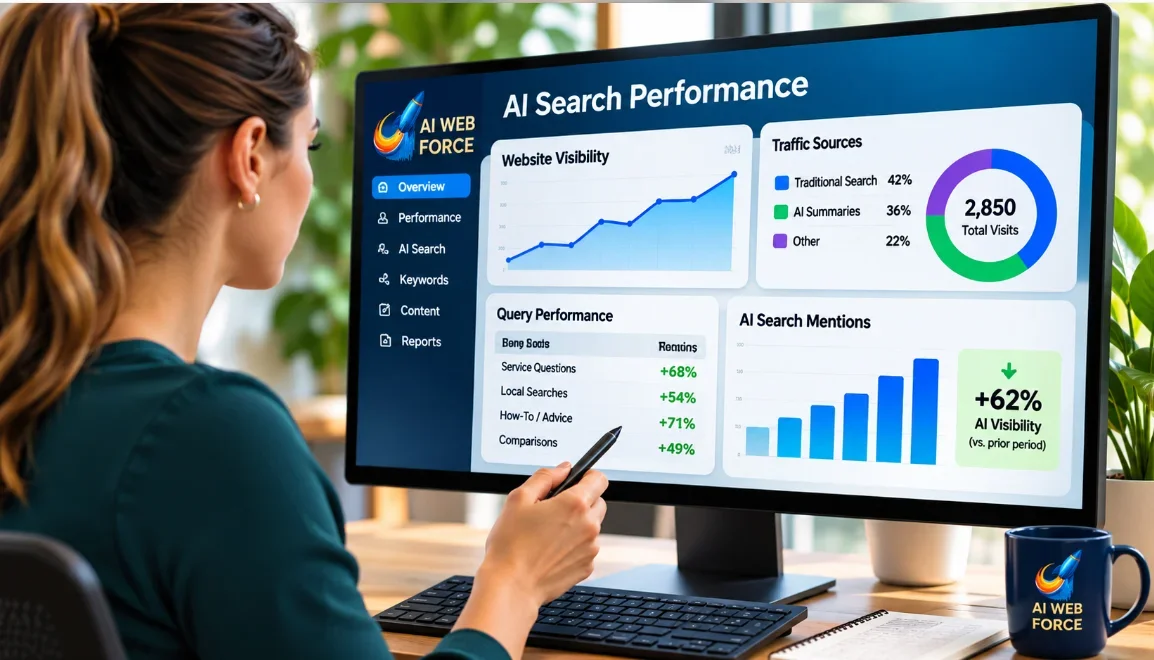
One local manufacturer recently revamped their FAQ page to answer highly specific customer questions (“How quickly can I get parts delivered in my city?” and “What certifications does your fabrication team hold?”). This original content was not only optimized for traditional SEO but started being cited directly in AI-generated search summaries—leading to more phone inquiries, even though their standard search result rank hadn’t changed.
Roofing contractors and professional services providers that actively update business profiles, encourage happy clients to leave reviews, and invest in clear, helpful online guides consistently see their content used in AI summaries.
These proactive steps prove that adapting to AI search trends is less about chasing algorithms and more about being genuinely helpful, authentic, and visible wherever customers look.
Common Questions About AI Search’s Rise and Impact
Why is Gen Z rejecting AI?
-
Analysis of Gen Z’s skepticism towards AI features and generative AI search, drawing on Pew findings and online behavior observations.
Pew Research found that while older demographics are embracing AI search, many Gen Z users remain skeptical.
This group is highly concerned about privacy, accuracy, and the risk of “algorithmic bias” from automated AI summaries.
They’re more likely to cross-check sources and may switch platforms if they sense that generative AI features aren’t transparent or reliable.
For businesses, this signals the need for authenticity, direct communication, and visible proof points when targeting younger consumers.
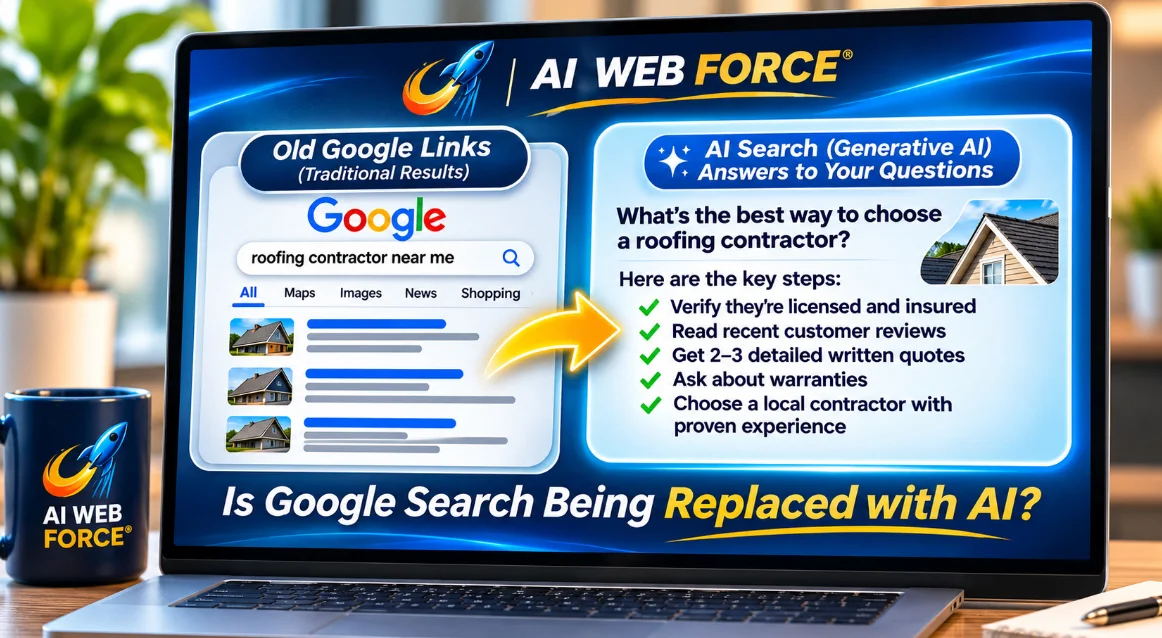
Is Google Search being replaced with AI?
-
Clarification: Google Search is integrating, not replacing, traditional results with AI summaries and conversational search features.
Google Search is not being entirely replaced by AI—but it is evolving. AI Overviews and conversational AI features are now integrated into the traditional search results, so users can access both the familiar “blue links” and advanced, AI-powered answers.
For website owners, this means you need to optimize for both traditional SEO and for visibility in AI responses.
What did Stephen Hawking warn us about AI?
-
Context on Hawking’s cautions about unchecked AI development, balanced with an evidence-based perspective on current search service applications.
Stephen Hawking warned about the potential risks of unchecked artificial intelligence, especially if systems outpace human oversight. However, current generative AI search features are designed mainly for information summarization and Q&A, not autonomous decision-making.
Businesses should stay informed but can focus on responsible, helpful engagement with current AI features rather than fearing distant dystopian scenarios.
How far away is AGI realistically?
-
Distinction between today’s generative AI features powering search and the more speculative Artificial General Intelligence (AGI).
Today’s generative AI search enhances how content is discovered, summarized, and personalized for user intent. While researchers continue to explore Artificial General Intelligence (AGI), the current wave of AI in search remains task-focused and human-guided. AGI—which would match human learning and reasoning across all domains—remains speculative and is not necessary for the advances we’re seeing in mainstream search services.
Key Takeaways: Preparing for the AI-Powered Search Era
-
AI search is mainstream, but traditional SEO and authoritative content still matter.
-
Website owners must balance foundational SEO strategies with readiness for generative AI search and AI features.
-
Adapt by answering user queries directly, improving content quality, and embracing rich media.
Businesses who combine credible SEO basics with readiness for AI summaries and generative AI features will reach people at every critical touchpoint in the digital age.
FAQs About AI Search, Business Impact, and Future Trends
-
Do I need to overhaul my website for AI search?
Not always. If your site already features original, well-organized, and up-to-date information, a few strategic updates (like adding FAQs and structured data) can boost your relevance for AI features. Focus on clarity and credibility to increase your odds of being cited in AI summaries. -
What type of content gets cited in AI summaries and generative AI search?
Content that directly answers customer questions, shows expertise, and provides transparent business info (credentials, certifications, reviews) is most likely to appear in AI summaries and generative AI search features. -
Will my existing SEO investment still pay off in an AI-powered search world?
Yes, foundational SEO remains vital. But adding helpful, up-to-date content that’s easy for AI to synthesize will maximize your success as AI search and generative AI become more prevalent.
This animated overview shows you how to quickly assess your website and digital marketing for AI search readiness in five steps.
Build Your Advantage: See How Ready Your Business Is for AI Search
-
Don’t miss your AI-powered growth opportunity. Start your free AI SEO Self-Scorecard and discover actionable ways to boost your visibility in the age of generative AI search: https://aiwebforce.com
Conclusion
AI search is now mainstream, but success depends on balancing traditional SEO with the new demands of generative AI features. Prepare, adapt, and your business can stand out in every digital discovery moment.
If you’re ready to take your digital strategy to the next level, consider exploring broader approaches to AI-powered marketing and website optimization. The main AI Web Force site offers a wealth of resources, expert insights, and advanced tools to help you stay ahead of evolving search trends and maximize your business’s online potential.